Dubai Property Registration & Legal Costs Explained

Written By
Amna
đź“…
Published On
16th Dec, 2025
⏱️
Min Reading
26 Min

As per the findings of Lykan’s Realty research team, the Dubai property market still can’t be figured out by just finding a lovely villa or apartment. The wise investors are aware that the price 0is just the beginning of the whole story. Government taxes, dealer commissions, and service charges are among the hidden costs, which might go up to 7% of the property value. 

Getting a good grasp on these costs right at the start is very important for the proper calculation of your actual Return on Investment (ROI) and for the avoidance of unpleasant financial surprises. This guide discloses each and every Dirham that you will have to pay during the transfer process, including DLD fees, agency commissions, legal costs, and the 2026 market projections.

Overview of Property Expenses Breakdown

Overview-of-Property-Expenses-Breakdown.

Initially, a comprehensive picture of your investment is necessary before getting into the minutiae. Acquiring a property in Dubai is a time-consuming process involving the payment of fixed government fees and the service costs that are determined by the property type. 

The biggest mistake that the first-time homebuyers in Dubai make is the underestimation of closing costs, which results in a very unpleasant surprise when they get to the last stage of the transaction due to the already stressed budget.Lykan’s Realty professionals say that you should have around 6% to 7% of the purchase price available as fees in cash. 

Having this financial buffer means that you will not be taken by surprise by the discrepancy in valuation or the sudden increase in trustee charges. A reference table is provided below for a quick visualization of the distribution of your money.

Estimated Cost Breakdown 

Fee Type Approximate Cost Payable To Payment Mode
DLD Transfer Fee 4% of Purchase Price Dubai Land Department Manager’s Cheque / DLD Pay
Trustee Fee AED 4,000 + VAT Registration Trustee Cash / Card
Agency Fee 2% of Purchase Price + VAT Real Estate Agent Cheque / Transfer
Conveyancing Fee AED 6,000 – AED 10,000 Conveyancing Firm Transfer
Mortgage Registration 0.25% of Loan Amount DLD Manager’s Cheque
Title Deed Issuance AED 580 DLD Cash / Card


Deep Dive into DLD Registration Fees

The Dubai Land Department (DLD) sets the legal basis for all real estate dealings in the emirate. Their fees constitute the largest share of your closing costs and are legally non-negotiable.

Understanding the 4% Transfer Fee Analyzed

The 4% property transfer fee is legally fixed as the basic fee charged for property registration in Dubai. This fee is payable only once to the government in order to effectuate the legal transfer of the ownership title from the seller to the buyer. 

While the law prescribes that the fee is to be equally divided (50/50) between the buyer and the seller, in reality, the market practice deviates considerably.

Who is Responsible for Payment?

In 90% of cases, the buyer pays the entire 4% fee as per current market norms. However, Lykan’s Realty team suggests negotiating this during the initial offer stage if the market favors buyers.

Calculating Your DLD Liability

Calculating this is straightforward but requires precision to avoid rejection at the trustee office. If you buy a villa for AED 3,000,000, your DLD fee is exactly AED 120,000.

Exceptions to the 4% Rule

In rare cases, developers may offer “DLD Waivers” as a promotional incentive during off-plan launches. This can save you tens of thousands of Dirhams on off-plan projects but is rare in the secondary market.

Registration Trustee Office Fees

You cannot walk directly into the DLD to register a standard sale anymore. You must use a Registration Trustee office, which acts as a satellite center for the government. These offices charge a service fee for processing the title deed transfer and verifying documents.

Fee Slabs for Properties

The cost depends entirely on the value of the asset you are purchasing. It is a fixed tier system, not a percentage, which benefits high-value investors.

Costs for Properties Under AED 500k

For affordable units, the trustee fee is AED 2,000 plus 5% VAT. This keeps entry-level investments accessible for studio buyers.

Costs for Properties Over AED 500k

For most properties in Dubai, you will pay AED 4,000 plus 5% VAT. This applies to the majority of freehold transactions in prime areas.

Title Deed Issuance Fees

Once the transfer fee and trustee fees are paid, you need the actual document. The property title registration document is your ultimate proof of ownership. The DLD charges a nominal administrative fee for printing and issuing this deed.

Standard Title Deed Costs

The current fee is AED 580 for a standard title deed issuance. This is usually collected alongside the 4% transfer fee at the counter.

Oqood Registration for Off-Plan

If you are buying off-plan, you get an Oqood certificate, not a title deed. The administrative fee for this is typically AED 1,000 plus knowledge fees.

Replacement for Lost Deeds

If you lose your original deed, a replacement costs significantly more. Expect to pay around AED 3,000 for a replacement certificate if you cannot produce the original.

Navigating Agency and Legal Costs

Beyond government taxes, you must pay the professionals who facilitate the deal. This includes real estate agents and legal conveyancers who ensure the safety of your funds.

Real Estate Agency Commissions

The broker acts as an intermediary between the buyer and the seller. The broker’s commission is uniform all over the emirate but may change according to the client’s requirements and the type of property. The majority of real estate companies, even the most reputable ones, impose a general fee of 2% plus VAT.

Understanding the 2% Standard

On a AED 2 million property, the agency fee is AED 40,000. Note that this fee is subject to 5% VAT, making the total check AED 42,000.

  • Negotiating Agency Fees: While 2% is standard, it is not written in stone law. In a slow market, you might negotiate this down to 1.5%, but top agents rarely discount their service.
  • Expat Real Estate Investment in Dubai:For expats, using a RERA-certified agent is non-negotiable. They ensure the property ownership documents are legitimate and unencumbered by hidden debts.

Conveyancing Fees Dubai Explained

Conveyancing denotes the legal process of transferring the property right from one person to another. Though not legally required, it is very risky to go on without it in a foreign country. A conveyancer will make sure that the Memorandum of Understanding (MOU) is in your favor.

Why You Need a Conveyancer

A conveyancer will take care of the property blocking and the transfer at the DLD in the end. They will also check that the property seller has paid all the service charges before the transfer so as not to cause a liability issue.

  • Average Conveyancing Charges: The legal fees for conveyancing professionals usually fall in the spectrum of AED 6,000 to AED 10,000. However, this is not a huge expense compared to the legal security and mental tranquillity that one would be assured of.
  • Verifying a Conveyancer’s Credentials: Always be sure that your conveyancer has a license from the Dubai Legal Affairs Department. The research team from Lykan Realty recommends verifying their experience in handling complicated transfers prior to employing their services.

Commercial vs Residential Conveyancing

Residential transactions are not as complicated as commercial ones. So, if you are dealing with offices or warehouses expect to pay at least AED 15,000 or more since that is what it costs to get a commercial license.

  • Leasehold Transfer Legalities: In this case, the legal transactions for leasehold properties are different from those of freehold properties due to the involvement of a third party. Most likely this will entail getting approvals from the master developer which in turn means more time and money as the case may be.
  • Freehold Transfer Legalities: Freehold transactions are more straightforward but nevertheless still demand proper legal documentation for properties in Dubai. This is to guarantee that your rights as a foreigner owner are permanently secured.

Mortgage Registration & Valuation Fees Explained

In case you are considering financing your investment, you should be ready for a different financial scenario as cash buyers. As per the survey conducted by the Lykan’s Realty team, the use of banking finance necessarily results in higher upfront costs.

 This is mainly due to the fact that banks in Dubai have their own strict set of administrative charges to process your loan application and thus, safeguard their assets.Banks in Dubai are meticulous and conservative with their resources. 

The banks will not give you even a Dh until they have gone through the whole process of valuation, security checks, and then mortgage registration fees at the Land Department in Dubai. This careful procedure does help to keep the market stable, but it also means that you will have to tie up more money during closing.

Property Mortgage Costs Breakdown

Taking a mortgage means the bank would be your partner in owning the property. To make this partnership official, the bank requires certain fees, which are not negotiable. These fees, or property mortgage costs, are in most cases paid directly to government agencies or service providers, so the bank cannot afford to give any of them up.

  • File Opening Fees: Most banks charge a nominal fee just to open your mortgage file.
  • Property Valuation: The bank needs independent confirmation of the asset’s worth.
  • Mortgage Registration: The DLD charges a fee to register the debt against the deed.
  • Life Insurance: A mandatory policy to cover the loan balance.

Mortgage Registration Fees Dubai

The most significant government levy in this category is the mortgage registration fee. The Dubai Land Department (DLD) charges this fee to officially register the mortgage against the property’s title deed. This legal step is crucial as it prevents the property from being sold or transferred without the bank’s explicit written consent.

The 0.25% Rule

The standard fee for this service is strictly calculated as a percentage of the loan amount, not the property value. You must pay 0.25% of the total loan amount to the DLD.

  • Example Calculation: If you take a loan of AED 1.5 million, your registration fee is AED 3,750.
  • Payment Method: This amount is payable via a Manager’s Cheque made out to the Dubai Land Department.
  • Timing: This must be paid on the day of the transfer at the trustee office.

Additional Admin Fees

On top of the variable 0.25% fee, there is a fixed standard charge. You will need to pay an additional AED 290 knowledge fee. While this is a minor addition to the overall property legal costs Dubai, it is a mandatory administrative cost that cannot be skipped.

Property Valuation Dubai Fees

Before a bank lends you money, they must know exactly what the property is worth in the current market. They will not rely on the asking price or the sales and purchase agreement. 

Instead, they will appoint a RERA-approved third-party valuer to assess the unit and ensure it acts as sufficient collateral for the loan value.

Standard Residential Valuation

For standard apartments and villas, property appraisal fees generally range from AED 2,500 to AED 3,500.

  • Direct Payment: This fee goes directly to the valuation firm, not the bank.
  • Non-Refundable: Even if the mortgage is rejected later, this fee is usually lost.
  • Validity: These reports are typically valid for only 3 to 6 months.

Valuation for Commercial Units

If you are investing in offices or retail spaces, the complexity increases. Commercial valuations are more technical and require detailed business analysis and yield projections. 

Consequently, fees can easily exceed AED 5,000 depending on the size and nature of the asset.

Impact on Loan-to-Value Ratio

According to Lykan’s Realty experts, the valuation report can make or break your deal. If the valuation comes in lower than the purchase price, the bank will only lend based on the lower valuation figure.

  • The Down Payment Trap: You must pay the difference in cash.
  • Common Pitfall: This is a frequent issue for the first-time homebuyer in Dubai who has not budgeted for this “valuation gap.”

Mortgage Pre-approval Costs

Getting pre-approved is the fundamental first step in getting mortgage financing approved in Dubai. It tells you exactly how much you can borrow before you start shopping.

 Some banks charge for this certificate, while others offer it for free as a competitive incentive.

Bank Processing Fees

Once you find a property and move to the final approval stage, banks typically charge a processing fee.

  • Rate: This is usually 0.5% to 1% of the loan amount.
  • Negotiation: This is often deductible from the final loan disbursement or can be waived during promotional periods.

Fixed vs Variable Rate Costs

Choosing a fixed rate might come with financial handcuffs. Fixed-rate mortgages often carry higher exit penalties to protect the bank’s interest margins. 

Always check the fine print regarding early settlement fees, which can be 1% of the outstanding balance (capped at AED 10,000 by Central Bank regulations).

Life Insurance Requirements

Banks strictly require you to have life insurance to cover the mortgage in case of death or terminal illness.

  • Bank Policy vs External: You can often find cheaper rates by using an external insurance provider rather than the bank’s in-house policy.
  • Impact: This is a monthly cost that directly impacts your long-term ROI and cash flow.

Service Charges and Ongoing Expenses

Buying the property is just the first financial hurdle. Maintaining it requires paying annual service charges to the owners’ association (OA) for the upkeep of common areas. 

According to the research team of Lykan’s Realty, neglecting to factor in these costs is the number one reason investors miscalculate their net rental yields.

Understanding the RERA Index

The Real Estate Regulatory Agency (RERA) strictly oversees these charges to prevent price gouging by management companies. They are calculated on a per-square-foot basis based on the net area (retail/living area) of the property, not the gross area.

  • Transparency: All approved service charges are published in the RERA Service Charge Index.
  • Audit: Every file charged must be audited and approved by government auditors before being billed to owners.

Service Charge Breakdown

These fees are not just for “cleaning.” They cover a wide array of essential services that keep the building livable and the asset valuable.

  • Security Staff: 24/7 guard presence.
  • Cleaning: Common areas, facade cleaning, and waste management.
  • Utilities: DEWA bills for the hallways, elevators, and lobby.
  • Pool Maintenance: Chemicals, heating, and lifeguard salaries.
  • Insurance: Building insurance (not content insurance).

Cost Range: These can range from AED 12 to AED 50 per sq. ft. depending on the luxury level and density of the project.

Impact of Location on Fees

Luxury areas like Downtown Dubai or Palm Jumeirah have significantly higher fees than suburban communities like Dubai Silicon Oasis.

  • High-End: Approx AED 25-45 per sq. ft.
  • Mid-Range: Approx AED 12-18 per sq. ft.
  • Result: High fees drastically affect your net rental yield and must be factored into your ROI.

Sinking Fund Contributions

A critical portion of your service charge goes into a “Sinking Fund” or Reserve Fund. This is a savings account for the building used for major capital repairs, like replacing elevators, chillers, or waterproofing the roof. This ensures the building’s longevity and prevents sudden “special levies” on owners.

Developer NOC Fees

To sell a property, the seller needs a No Objection Certificate (NOC) from the developer. This document confirms that no service charges are outstanding and the property is clear for transfer. Without this, the DLD will not execute the sale.

Cost of the NOC

Developers charge an administrative fee for issuing this certificate.

  • Range: Anywhere from AED 500 to AED 5,000.
  • Responsibility: It is usually paid by the seller, but Lykan’s Realty advises checking your MOU contract terms to be sure.

Validity of the NOC

These certificates are time-sensitive. They are often valid for only 15 to 30 days.

  • Timing: Timing your transfer is crucial. If the deal delays beyond the validity period, you will have to pay for a second NOC.

Developer Delays and Issues

Sometimes developers delay issuing NOCs due to minor disputes or system errors.

  • Expert Tip: Lykan’s Realty team recommends applying for this at least 14 days before transfer to allow buffer time for resolving any hidden account discrepancies.

Hidden Move-In & Utility Costs

Beyond the purchase price and government taxes, moving into your new Dubai home triggers a wave of connection fees. These “hidden” costs are often ignored until the final week, causing unnecessary stress and cash flow issues.

DEWA & District Cooling Setup

The Dubai Electricity and Water Authority (DEWA) is the primary utility provider for the emirate. Unlike some countries where utilities are transferred automatically, here you must pay security deposits to activate services.

DEWA Security Deposits

  • Apartments: The standard refundable deposit is AED 2,000.
  • Villas: This deposit doubles to AED 4,000 due to higher potential consumption.
  • Activation Fees: On top of the deposit, there is a non-refundable activation fee of approximately AED 130 to AED 300. This covers the administrative cost of setting up your account and initial meter reading.

Empower & District Cooling

In many freehold areas like JVC, Business Bay, and Dubai Marina, air conditioning is provided by centralized district cooling firms like Empower or Emicool.

  • Registration: They charge a connection fee of AED 2,000 plus a refundable deposit.
  • Meter Setup: You may also pay for the registration of the BTU meter.

Chiller Demand Charges

District cooling bills have two distinct parts: consumption and “Demand Charges”.

  • Demand Charge: This is a fixed yearly fee (approx AED 750 per Refrigeration Ton) payable quarterly, regardless of whether you turn on the AC or not.
  • Impact: This acts like a fixed tax on the property and must be paid by the landlord if the property is vacant.
Gas Connection Fees

If your building uses a central gas system, companies like Lootah Gas require a separate registration.

  • Deposit: This is typically AED 1,000 to AED 2,000 depending on the provider.
  • Safety: They will also charge for a safety inspection before turning on the supply.

Visa & Residency Costs

For many foreign investors, the property comes with the benefit of a residency visa. However, the visa itself is not free and involves medical and administrative costs.

2-Year Investor Visa Fees

The standard property investor visa (for properties worth AED 750k+) costs between AED 3,500 and AED 4,200.

  • Inclusions: This covers your medical fitness test, Emirates ID typing, and visa stamping.
  • Renewal: This fee recurs every two years.

Golden Visa (10-Year) Costs

For properties worth over AED 2 million, you qualify for the Golden Visa.

  • Total Cost: The total government cost for this 10-year residency is approximately AED 5,000 to AED 6,000 per applicant.
  • Benefit: This is a self-sponsored visa that allows you to work and live in Dubai for a decade.

Medical & ID Typing Fees

Every visa application requires a blood test and chest X-ray to rule out communicable diseases.

  • VIP Service: VIP medical services cost around AED 700-800 for fast-track results (2-4 hours).
  • Standard Service: Government clinics charge less but take longer (24-48 hours).
Family Sponsorship Costs

If you plan to sponsor your family, multiply the visa costs. You will also need to pay a file opening fee and a refundable deposit (approx AED 3,000) for each dependent.

 Off-Plan vs Secondary Market Cost Comparison

The cost structure varies significantly depending on whether you buy a brand new unit or a resale property. Understanding the off-plan vs ready property cost dynamics helps in choosing the right strategy for your capital.

Buying Off-Plan (Primary Market)

Off-plan properties are purchased directly from the developer during construction. These often come with attractive payment plans that spread the cost over several years, easing the entry barrier.

Oqood Registration Fees

Instead of a title deed, you pay 4% for Oqood (pre-title) registration. This is the mandatory DLD fee for properties under construction.

  • Protection: This registers the unit in your name and protects your rights while the building is under construction.

Payment Plan Nuances

Developers often absorb the DLD fee as a marketing incentive.

  • DLD Waivers: A “50% DLD Waiver” means you only pay 2% instead of 4%, saving you thousands of Dirhams.
  • Post-Handover: Some plans allow you to pay 40% of the price after getting the keys, which boosts your ROI.

Handover Administrative Charges

Upon completion, developers may charge an “admin fee” for the handover process.

  • Coverage: This covers the final snagging inspections, key handover processes, and utility registration assistance.

Buying Resale (Secondary Market)

Secondary market properties are ready to move in but require full payment upfront. The property expense breakdown here is more front-loaded and cash-intensive.

  • Transfer Fees

You pay the full 4% DLD fee immediately on transfer day.

No Waivers: There are virtually no DLD waivers in the secondary market unless the seller agrees to cover it (which is highly unlikely in the current seller’s market).

  • Conveyancing Necessity

Conveyancing is critical here to check for blocking.

Due Diligence: You must ensure the previous owner has no outstanding mortgage, service charge debts, or court blocks on the property.

  • Renovations & CAPEX

Resale units often need renovation to meet modern standards or fetch high rents.

Budgeting: Lykan’s Realty advises budgeting 10-15% of the property value for upgrades if the unit is older than 10 years.

Is it a Good Time to Buy Property in Dubai?

With the costs laid out, the question remains: is the timing right? According to the research team of Lykan’s Realty, the Dubai real estate market 2026 outlook remains positive with sustained growth, driven by population influx and economic stability.

Market Trends and ROI

Analysts predict steady growth in capital appreciation. However, entry costs are rising, making now a vital time to lock in prices before they climb further. The window for “bargain hunting” is closing as the market matures.

Best Property Projects in Dubai for Foreign Investors

Foreign investors should focus on integrated communities. Off-plan projects often come with payment plans that ease the burden of upfront fees.

  • Recommendation: Look for developers offering post-handover payment options to maximize cash flow and reduce initial capital outlay.

Off-Plan vs Ready Property

Off-plan vs ready property is a classic debate.

  • Ready Properties: Yield immediate rent but require full upfront cash or mortgage financing. Best for those needing immediate housing or income.
  • Off-Plan: Best for capital appreciation and flexible payments.

High Yield Areas

Areas like JVC (Jumeirah Village Circle) and Arjan offer lower entry costs and high yields.

  • Strategy: Investing here offsets the high property registration costs Dubai and boosts your annual return due to high occupancy rates.

Strategic Investment Advice

Do not just look at the price tag. Look at the “price per square foot” plus the accrued service charges over 5 years to get the real cost of ownership.

How to Negotiate Dubai Property Price

Sellers often price their units to cover their original fees.

  • Data-Driven: Use the independent valuation report to negotiate a fair market value based on data, not emotion.
  • Leverage: Cash buyers can often negotiate 2-5% off the asking price compared to mortgage buyers.

Common Mistakes Buying Property in Dubai

The biggest mistake is ignoring the closing costs.

  • Budget Fail: Failing to budget for the 4% DLD fee can kill a deal at the last minute and forfeit your security deposit (usually 10% of the property value).
Choosing the Right Agent

How to choose real estate agent Dubai is critical. A good agent will warn you about upcoming special levies or maintenance issues that could cost you later. They act as your risk manager, not just a salesperson.

Strategic Investment & Market Timing 2026

The year 2026 is poised to be a pivotal year for Dubai real estate. With new regulations and a maturing market, timing your entry is as important as the location. Lykan’s Realty team predicts a shift towards end-user dominance, stabilizing rental yields.

ROI Calculations

Gross yield is simply annual rent divided by purchase price. However, this is a vanity metric. Net yield subtracts service charges and maintenance. Always calculate Net Yield to see the real profit potential.

Gross vs Net Yield

  • Scenario: A property might show 8% gross yield.
  • Reality: After paying AED 15/sq ft service charges, the net yield might drop to 5.5%.
  • Advice: Be realistic with your spreadsheets.

Impact of Fees on Flipping

If you plan to “flip” (sell quickly), you must be extremely cautious.

The Breakeven Math: Remember the 8% entry/exit cost breakdown (4% buy DLD + 2% buy comm + 2% sell comm + 4% sell DLD impact on price).

Result: You need the market to rise at least 10% just to break even. Flipping is high risk in a stable market.

  • Legal Pitfalls to Avoid

Scams are rare in Dubai due to strict laws, but they exist in the details. Ensure your agent is RERA registered (check their Broker Card) and never pay cash to an individual—always to the agency or trustee.

  • Fake Listings & Fraud

Be wary of listings priced significantly below market value.

Bait and Switch: These are often tactics to get your phone number. If it looks too good to be true, it is.

Due Diligence Checklist

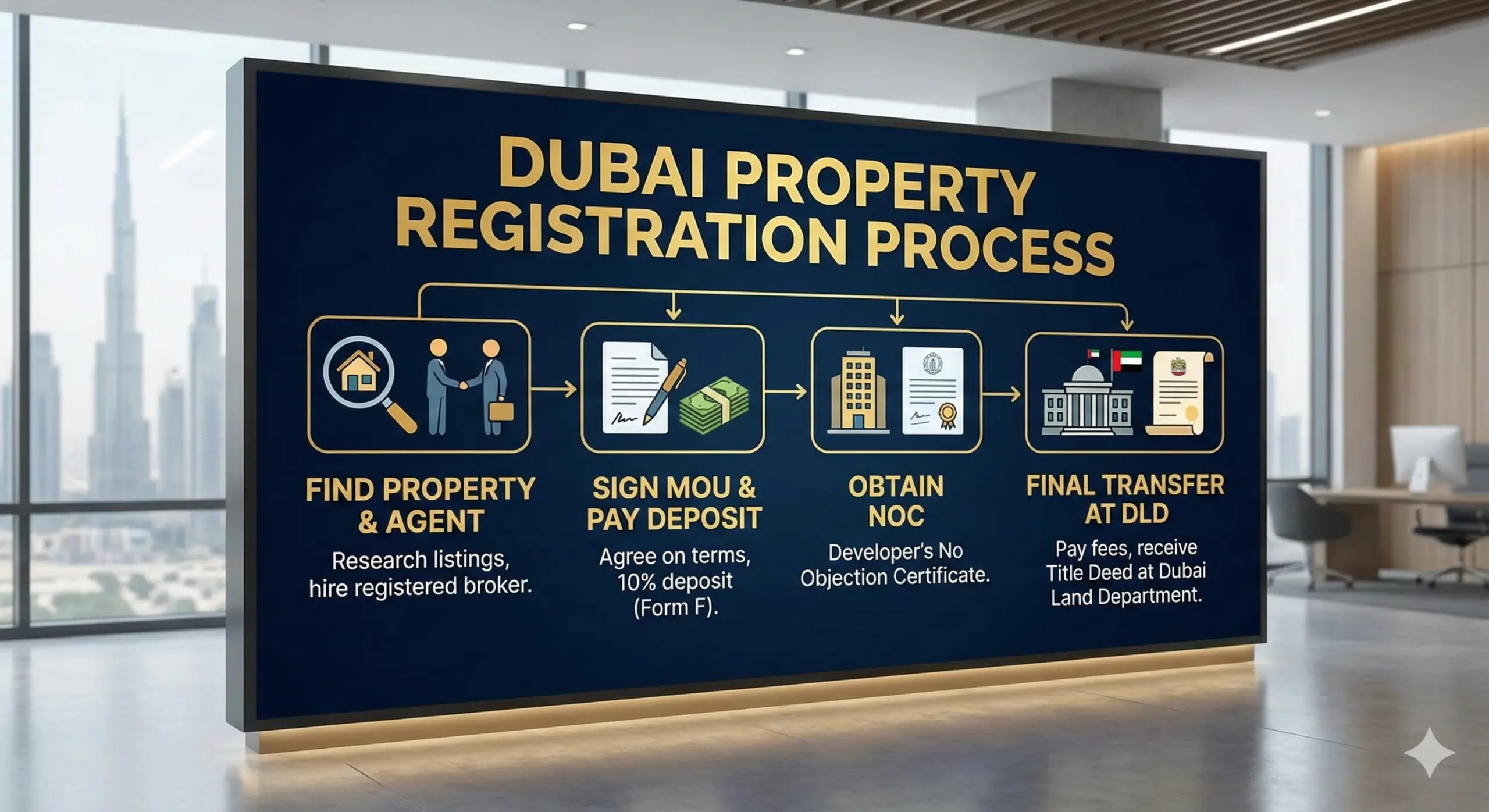
Before signing Form F (MOU), complete this Lykan’s Realty checklist:

  • Verify Title Deed: Is the seller the legal owner?
  • Check Service Charge History: Are there arrears?
  • Confirm Developer NOC Status: Are there blocks on the unit?
  • Inspect Property: Check for structural issues or mold.

RERA Dispute Process

If a dispute arises, the RERA Rent Dispute Center (RDC) is efficient. However, filing a case costs 3.5% of the rental amount, so negotiation is always a better financial option than litigation.

Expert Tips and Notes

  • Tip 1: Always carry a manager’s cheque for the exact DLD amount. The trustee office usually does not accept personal cheques or credit cards for the government fee.
  • Tip 2: If you are buying with a mortgage, ask your bank if they can include the DLD fee and agency fee in the finance package. Some banks allow this up to a certain limit.
  • Note: Keep all receipts of property expense breakdown. These costs can sometimes be deducted from capital gains taxes in your home country, depending on your tax residency.
  • Tip 3: For expat real estate investment in Dubai, consider opening a local bank account early. Transferring large sums internationally can trigger AML checks that delay closing.

Pros and Cons of Dubai Property Fees

Pros Cons
Transparency: Fees are standardized and published by the government. High Entry Cost: The 4% DLD fee is higher than some global markets.
Speed: The property registration process is incredibly fast (often 2 hours). Upfront Cash: Most fees must be paid in cash/cheque, not financed.
Tax-Free: No annual property taxes or capital gains taxes in Dubai. Variable Service Charges: Maintenance fees can rise annually.
Security: Government-backed trustee offices ensure zero fraud. Non-Refundable: Once paid, DLD fees are almost never refunded.
Digital Integration: The Dubai REST app allows remote tracking. Hidden Levies: District cooling demand charges can be a shock.

Why This Blog is Beneficial for Users

According to Lykan’s Realty research and expert team, this guide serves as a financial safeguard. We have seen too many investors lose their deposit because they could not cover the closing costs. 

By providing a detailed property expense breakdown, we empower you to budget with 100% accuracy. This content bridges the gap between confusing legal text and real-world financial planning.

We don’t just list fees; we explain why they exist and how to pay them. This depth of knowledge is what separates a successful investor from a stressed one.

Expert Opinions

  • “The Dubai real estate legal guide is straightforward, but the volume of small fees catches people out. A 10% buffer on top of your deposit is the golden rule for safety.”
    — Senior Conveyancer, Dubai
  • “We are seeing a trend where sellers are refusing to split the DLD fee. It is now almost exclusively a buyer’s expense in this high-demand cycle.”
    — Head of Sales, Lykan’s Realty
  • “Investors often forget the district cooling deposits. For a large apartment, this can sit at AED 5,000 sitting idle. Factor this into your cash flow.”
    — Property Management Director, Dubai Marina
Conclusion

Navigating Dubai property registration and legal costs does not have to be overwhelming. While upfront fees are significant, the absence of recurring property taxes makes Dubai highly competitive on a global scale.

According to the Lykan’s Realty blog team, the key to a successful purchase is preparation. When buyers clearly understand property legal costs in Dubai, supported by official guidance from the Dubai Land Department (DLD) on ownership registration, transfer procedures, and applicable fees, they can negotiate from a position of strength. Whether you are a first-time homebuyer in Dubai or a seasoned investor, cost transparency remains one of your most valuable assets.

It is equally important to ensure that all property ownership documents are in order and that residency or visa-related considerations are aligned. Information provided by the General Directorate of Residency and Foreigners Affairs (GDRFA Dubai) helps buyers stay informed about residency implications connected to property ownership, especially for long-term investors.

With your documentation prepared and budget approved, the Dubai real estate market in 2026 offers strong opportunities for well-informed buyers. For further insights and direct assistance with property transfers, legal procedures, and investment planning, contact the Lykan’s Realty team today.

Frequently Asked Questions 

  1. What is the total property registration cost in Dubai?
    Generally, you should budget 6.5% to 7% of the purchase price. This covers the 4% DLD fee, 2% agency fee, and miscellaneous trustee and legal costs.
  2. Can I finance the DLD registration fees?
    Most mortgage lenders in Dubai do not allow you to finance the DLD fee; it must be paid upfront. However, a few specific banks may offer “fee financing” products, so it is worth asking.
  3. Who pays the conveyance fees in Dubai?
    The buyer typically pays the conveyancing costs. It is a service to protect the buyer’s money and rights during the transfer process.
  4. How long does the property registration process take?
    Once the NOC is issued, the actual transfer at the Trustee office takes about 60 to 90 minutes. You walk out with the title deed in hand.
  5. Are there different rules for Dubai property ownership laws for foreigners?
    Yes, foreigners can only buy in designated “Freehold” areas. In these areas, you have absolute ownership rights, exactly like a UAE national.
  6. Do I have to pay VAT on property fees?
    Yes, 5% VAT applies to all service-based fees. This includes the agency commission, trustee fee, valuation fee, and conveyancing fee. The 4% DLD fee itself is exempt from VAT.
  7. Can I get a refund on the DLD fee if I cancel the purchase?
    No, once the transfer is executed, the DLD fee is non-refundable. If the deal cancels before transfer, you haven’t paid it yet.
  8. What is the difference between Oqood and Title Deed?
    Oqood is an interim registration for off-plan properties. A Title Deed is the final ownership document for completed, ready properties.
  9. Are service charges the same in every building?
    No, they vary wildly. A luxury tower with a concierge and gym will cost AED 25/sq ft, while a simple building in International City might be AED 12/sq ft.
  10. How much is the penalty for late registration?
    If a developer delays Oqood registration, they face fines. As a buyer, if you delay the transfer after signing the MOU, you may lose your 10% deposit.


About The Author