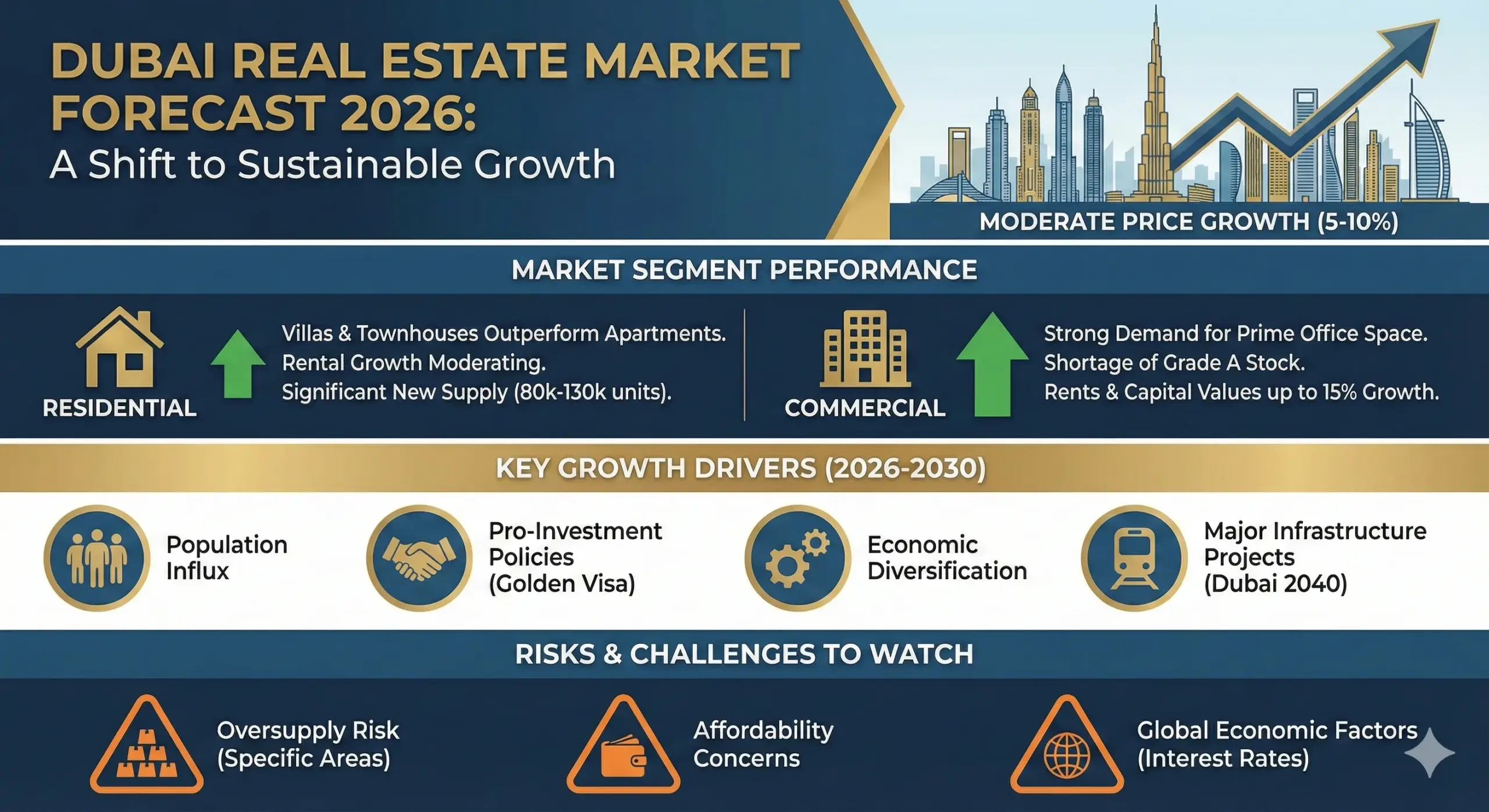
Dubai’s real estate market has consistently attracted global investors due to its high ROI, world-class infrastructure, and investor-friendly regulations. According to Lykans Realty, the Dubai real estate market forecast 2026-2027 shows strong growth potential in both residential and commercial sectors.
Foreign buyers looking for Dubai property investment 2026, luxury villas, or Dubai apartments and villas 2026 will find abundant opportunities in prime locations.
This guide provides a detailed Dubai property market 2026 outlook, including Dubai property price trends 2026-2027, Dubai rental yield 2026, and investment strategies tailored for foreign investors. Every section is structured in simple, easy-to-read paragraphs to help investors make informed decisions about the Dubai property market.
Why Dubai Remains a Top Investment Destination

Dubai continues to outperform many global real estate markets due to its transparency, legal safeguards, and strong rental demand. Investors looking at Dubai real estate demand 2026 will find a market with growing Dubai luxury villas market 2026, off-plan property 2026, and high-yield apartments.
Key factors making Dubai attractive include:
- 100% foreign ownership in freehold areas
- Tax-free rental income and capital gains
- Strong regulatory framework through RERA Dubai and Dubai Land Department
- High rental yields compared to India and other global cities
With Dubai property growth predictions showing steady appreciation, Dubai remains one of the safest and most profitable destinations for property investment.
Dubai Real Estate Outlook 2026-2027
The Dubai real estate outlook 2026-2027 suggests a balanced market with moderate price growth, rising rental yields, and strong demand for both residential and commercial spaces. Key trends include:
- Steady Dubai property price trends 2026-2027 with selective growth in luxury and waterfront properties
- Increased demand for Dubai apartments and villas 2026 in premium communities like Downtown Dubai, Dubai Marina, and Palm Jumeirah
- Rise of Dubai off-plan property 2026 as developers offer flexible payment plans and escrow-protected investments
- Strong Dubai rental market trends due to a growing expat population and tourism sector
Investors focusing on Dubai prime property market and UAE property market 2026 opportunities are likely to benefit from consistent rental income and long-term capital appreciation.
What Is Driving the Dubai Real Estate Market Forecast 2026-2027?
Population Growth and Demographic Pressures
The estimate of the population of Dubai is over 4 million residents, to which about 1,000 new residents per day are added. The Dubai 2040 Urban Master Plan foresees a population increase up to about 5.8 million people by the year 2040, thereby generating an unceasing demand for residential properties of all types all over Dubai.
Besides, this demographic trend makes it certain that the new housing that will be built in the market will be filled with actual demand only and not speculation, which aligns with the long-term market resilience perspective taken by the research team of Lykan’s Realty.
Moreover, the decline in the average size of the households in Dubai from 4.5 to a projected 3 people per household has made the demand for housing even greater. On the other hand, according to the latest forecasts, the record delivery of 99,686 apartment units and 15,284 villas in 2026 will still not be able to meet the demand.
The Market Research Division of Lykan’s Realty estimates that over the next twelve months, the demand for housing based on current growth has the potential to range between 65,000 to 80,000 units per year after which a balanced supply-demand condition would occur in the period under review of 2026-2027.
Economic Diversification and Foreign Investment
Dubai’s economy has changed considerably, and it no longer depends on oil. Now, the sectors of tourism, technology, finance, and logistics are sustaining growth. The Golden Visa program has brought over 100,000 new residents, with the average high-net-worth person owning 2.3 residential units.
The year 2026 saw more than 9,800 millionaires moving to the UAE, therefore, the luxury real estate market and mid-market demand have been positively affected by this trend.
Supply Pipeline Analysis for 2026-2027
The supply wave that is foreseen for 2026-2027 is very large but still manageable due to demand fundamentals. The new inventory in 2026 includes around 99,686 apartment units, and the villas are 15,284. Moreover, an additional 62,966 apartments and 5,631 villas are expected to be completed in 2027.
Nevertheless, past trends suggest that 30-40 percent of the expected supply will usually be delayed, thus the actual number of units delivered will be in the range of 60,000-70,000 for 2026 and similar for 2027.
The researchers from Lykan’s Realty state that this postponement in delivery has a great impact on reducing the supply risk. The construction cycle has shown a major improvement from 1340 days in 2023 to about 880 days in 2026, which is a clear indicator of better project execution.
The delivery of the supply, which is big in terms of volume, is staggered over 2026 and 2027 and thus gives the market enough time to take in the new inventory and avoid drastic price corrections, thus the stabilization narrative is supported.
Off-Plan Market Dominance and Payment Flexibility
The sixtieth percentile of the overall housing market was taken by off-plan properties in 2026, with lower capital necessity being the main reason for the popularity of the flexible payment arrangements. Developers are still providing their clients with a variety of payment plans, such as the post-handover scheme with 60-40 or 70-30 staging, making it easy for young buyers and those with average income to invest in property.
The off-plan category is anticipated to be at the forefront throughout 2026-2027, with the high-end launches in Dubai Creek Harbour, Dubai South, Jumeirah Village Circle (JVC), and new extensions of MBR City.
The analysis performed by Lykan’s Realty research team reveals that the early-cycle off-plan buyers are still inheriting 10-30 percent appreciation potential during the whole cycle from the launch to the handover which keeps the investor demand high even with the supply wave incoming.
Dubai Real Estate Market Conditions 2026-2027: A Detailed Price Forecast

Anticipated Price Movements Across Market Segments
Dubai’s real estate market is composed of various segments, and the performance of each segment will be affected by the location. The research team of Lykan’s Realty believes there will be three different themes in the market for the years 2026-2027 consisting of resilience of prime segment, stabilization of mid-market and growth of emerging areas.
Prime and Luxury Segment (5-7% increase in value): The properties located in Palm Jumeirah, Downtown Dubai, Dubai Marina, and Jumeirah Bay Island are predicted to be strong and will be kept strong due to the combination of limited availability and continuous demand from rich people. The prime segment which is responsible for 15-20 percent of total transactions by value attracts the so-called wealth preservation capital that is unaffected by mid-market cyclicality.
Mid-Market Segment (up to 10% downward adjustment): The price levels in places like JVC, Business Bay, Al Furjan, and Arjan may remain flat or they could be adjusted upward or downward modestly by 0-10 percent. This is due to the fact that a heavy supply from ongoing developments is affecting negotiating dynamics. Fitch Ratings claims that there will be a 10-15 percent correction in oversupplied segments, however, research from Lykan’s Realty team indicates that this will not be a widespread phenomenon but will occur in specific sub-markets.
Emerging and Secondary Communities (8-15% price rise): The areas of new master-planned communities using infrastructure corridors—Dubai Creek Harbour, Dubai South, Sobha Hartland II, and Expo City—are expected to see prices go up by 8-15 percent through 2026-2027 as the completion of the infrastructure and migration of residents create demand. These “opportunity zones” are said to carry less investment risk but require the investor to have patience with a longer exit time.
Why Is Dubai Market Stabilization Happening Now?
Market stabilization in 2026-2027 reflects the transition from explosive growth to sustainable maturity. Previously, Dubai’s real estate market was characterized by supply constraints driving prices up rapidly; today, deliberate supply increases by authorities represent a strategic effort to improve affordability and prevent market overheating.
The Dubai Urban Master Plan 2040 emphasizes creating mixed-use, sustainable communities that attract residents through livability rather than speculation. This policy-driven shift creates a “goldilocks” scenario: sufficient new supply to ease affordability and rental pressure, yet not so much supply as to trigger market crashes. Lykan’s Realty team analysis indicates that this balance point is achievable through 2026-2027, supporting the stabilization outlook.
Construction Delays and Their Impact on Supply Forecasts
Historical delivery data reveal a consistent pattern: only 56 percent of projected units are actually delivered on schedule. Between 2022 and 2024, developers delivered just 97,000 of 174,000 projected units—a 56 percent completion rate. For the 2026-2027 forecast period, applying a similar adjustment factor means actual deliveries will likely total 65,000-75,000 units annually rather than the published 120,000+ figures.
This structural underperformance of delivery projections is beneficial for market balance. Construction delays provide a natural “shock absorber” that reduces oversupply risk, extends absorption timelines, and prevents sudden rent or price collapses. Lykan’s Realty team emphasizes that investors should plan on actual supply being 30-40 percent below published forecasts when modeling their investment returns.
Dubai Housing Market Trends 2027: Rental Market Outlook and Yield Stabilization
Rental Market Stabilization: What Investors Should Expect
Rental prices soared by 25-29 percent yearly during 2023-2026, which made it difficult for tenants to afford and even brought the situation under the spotlight of international attention. The researchers at Lykan’s Realty estimate the rental increase to be 3-8 percent per annum during 2026-2027 because of the new supply coming into the competitive market.
This stabilization of rental growth is beneficial for the future of the real estate market in Dubai. Continuous double-digit rent growth can be the cause of the wage-price spirals, which eventually lead to the discouragement of business expansion and the ceasing of expatriate relocations. On the other hand, the rise in rental prices that is controlled and moderate still bears the city’s tag of being a talent pool and business-friendly place thus protecting the economic drivers of property that demand the Dubai market.
The change from erratic rent growth to a more uniform pattern is in the case of investors neutral to positive: the attractive annual yields of 6-8 percent in the established communities and 7-9 percent in the high-yield corridors like JVC and Dubai Silicon Oasis are still on offer, while, as the landlords are swamped with supply, the vacancy risks that the tenants used to face are disappearing.
| Area | Avg. Rental Yield | Property Type Focus | 2026 Outlook |
| JVC (Jumeirah Village Circle) | 7.59% | Apartments, Townhouses | Stabilizing, abundant supply |
| Dubai Silicon Oasis | 8.09% | Mixed residential | High demand, tech sector growth |
| Dubai Sports City | 8.14% | Affordable apartments | Competitive, new supply |
| Jumeirah Lake Towers (JLT) | 7.32% | Premium apartments | Stable, mature market |
| Downtown Dubai | 6-7% | Luxury apartments | Tourism-driven, premium yields |
| Dubai Marina | 6-7% | Mixed luxury residential | Waterfront premium, consistent |
Residential Market Forecast 2027: Which Property Types Will Outperform?
The gap between the two housing types in the luxury market will become even wider during the years 2026-2027. Villas have already reached an impressive 318.5 index point mark compared to just 184.2 for apartments (with January 2021 being the reference point), thus indicating that only a few villas will be available (there will be 15,284 new units in 2026 against 99,686 apartments) and strong demand coming from families and wealthy people wanting privacy and ownership of land.
- Villa Market Forecast: The villa segment is forecast to maintain 5-10 percent annual appreciation through 2026-2027, supported by land scarcity in core districts and sustained demand from affluent buyers. Prime villa communities such as Dubai Hills Estate, Arabian Ranches, Jumeirah Golf Estates, and emerging waterfront villas will command capital appreciation premiums. However, rental yields remain lower at 4-6 percent annually, making villas suitable for capital growth investors rather than income-focused strategists.
- Apartment Market Forecast: The apartment sector faces more substantial supply pressure, with 99,686 new units in 2026 alone. However, these units will be distributed across numerous communities and price points, mitigating concentration risk. Entry-level and one-bedroom apartments (AED 1.5-3 million price range) will remain in demand from young professionals, digital nomads, and service-sector workers whose numbers are expanding alongside Dubai’s economic diversification. Lykan’s Realty team research indicates that well-located apartment investments in yield-focused communities will continue generating competitive 6-8 percent returns even amid price stabilization.
Which Neighborhoods Will Dominate Dubai Property Market 2026-2027?
- Dubai Creek Harbour: The waterfront development is poised to become Dubai’s “second Downtown,” combining residential appeal with commercial vibrancy. Expected 2026 handovers of Dh-branded towers and creek-view apartments support rental yields of 6-6.5 percent. Future value appreciation is likely as the creek activation progresses and waterfront premiums normalize globally.
- Dubai Hills Estate: This mature, family-oriented community continues to outperform as end-users prioritize space, schools, and lifestyle amenities. Upcoming 2026-2027 handovers of new phases, combined with limited freehold villa supply, support 5-7 percent rental yields and 5-10 percent annual capital appreciation.
- Jumeirah Village Circle (JVC): One of Dubai’s most affordable communities, JVC combines 7-8 percent rental yields with accessibility pricing (apartments starting around AED 750,000). Planned metro expansion and retail growth provide appreciation catalysts, positioning JVC as the leading mid-market investment hub for 2026-2027.
- Dubai South and Expo City: Airport proximity, new commercial development, and sustainability focus create 6-8 percent rental yield potential and 12-15 percent medium-term appreciation. Expo City’s mixed-use design and ESG credentials attract ESG-conscious investors and millennial families.
- Palm Jumeirah and Palm Jebel Ali: Limited supply and ultra-premium positioning ensure continued price appreciation for primary residents and wealth preservation investors. New villa communities launching on Palm Jebel Ali will command 3-5 percent yields but offer significant capital appreciation potential for long-term holders.
Off-Plan vs Ready Property in Dubai Real Estate Market 2026
Off-Plan Property Investment Strategy: Advantages and Risks
Off-plan properties represent 74 percent of Dubai’s transaction volume in 2026, driven by lower entry prices (often 10-30 percent below comparable ready units) and flexible payment plans. For capital appreciation-focused investors with 3-5 year holding horizons, off-plan investment remains optimal.
Advantages of Off-Plan Investment:
- Lower Entry Price: Early-stage launches often price 15-25 percent below anticipated handover levels, creating built-in appreciation potential
- Flexible Payment Plans: Developers offer 60-40, 70-30, or post-handover payment schemes, reducing upfront capital requirements
- Customization Options: Select finishes, layouts, and locations within projects before handover
- Assignment Potential: Policies allowing assignment prior to handover enable profit realization before completion (subject to developer rules and percentage paid)
- Tax Efficiency: Golden Visa eligibility potentially available immediately upon purchase of AED 2 million+ properties
- Developer Incentives: Furniture packages, maintenance periods, and rental guarantees often accompany off-plan launches
Risks of Off-Plan Investment:
- Construction Delays: 30-40 percent of projects face delays extending timelines by 12-36 months
- Liquidity Risk: Mid-construction liquidity is limited; buyers cannot easily exit without accepting discounts
- Market Cycle Risk: Price adjustments may occur between purchase and handover, especially during economic downturns
- Quality Risk: Finished product may not meet specification expectations outlined in promotional materials
- Service Charge Uncertainty: Future maintenance charges can exceed projections in newly completed communities
For investors willing to accept these risks in exchange for appreciation potential, off-plan purchases in established developer portfolios (Emaar, Damac, Sobha, Nakheel) remain attractive through 2026-2027.
Ready Property Investment: Stability and Immediate Returns
The properties that are ready for occupancy and have been completed come out as the first option for those focusing on income, those who are going to live in the property and risk-averse planners. Whereas the prices are higher than in the case of off-plan properties, the ready properties bring along, among other things, the certainty, the immediate rental income, and easier financing.
| Dimension | Off-Plan Properties | Ready Properties |
| Entry Price | 10-30% below ready comps | Full market price |
| Payment Terms | Flexible, often 60-70% post-handover | Down payment + mortgage |
| Rental Income | None until handover | Immediate from purchase |
| Capital Appreciation | High potential (15-30% by handover) | Moderate (3-8% annually) |
| Financing | More restrictive, LTV often lower | Standard mortgages available |
| Liquidity | Low during construction | High, straightforward sale process |
| Inspection | Model units and renderings only | Full property inspection possible |
| Time Horizon | 3-5+ years | Flexible, quick exit possible |
| Buyer Profile | Capital growth seekers | Income and stability focused |
Advantages of Ready Property Investment:
- Immediate Income: Rental potential from day one after purchase and registration
- Certainty: Physical inspection and exact finishes known before purchase
- Mortgage Accessibility: Banks more comfortable with ready properties; higher LTV typically available
- Market Data: Comparable sales and rental benchmarks easily verified through market records
- Shorter Investment Cycle: Quick resale possible if circumstances change
- Stable Valuation: Established communities have predictable valuation methodologies
Optimal Strategy for 2026-2027: The analysis from Lykan’s Realty team came up with a balanced portfolio approach including 40-50 percent off-plan allocation (for capital appreciation) plus 50-60 percent ready property allocation (for income stability) as giving riskiest risk-adjusted returns.
This mixture not only captures appreciation potential but also produces steady cash flow, resulting in the creation of resilience during every market cycle.
Dubai Real Estate Investment Opportunities: Best Property Projects and Top Investment Neighborhoods
Best Property Projects in Dubai for Foreign Investors 2026
- Emaar Properties: Flagship communities like Dubai Creek Harbour, Emaar Beachfront, Dubai Hills Estate, and The Valley span mid-market to ultra-luxury. With 2026–27 handovers, strong infrastructure completion, and prime waterfront or green-community positioning, expected appreciation ranges 5–10% annually.
- Damac Properties: Focused on lifestyle-driven, mid-market to premium projects such as Damac Lagoons, Riverside, and branded residences. Flexible payment plans and branding appeal to first-time buyers and investors seeking rental and lifestyle demand.
- Sobha Group: Known for superior build quality. Sobha One and Sobha Hartland II villas target premium and ultra-luxury buyers, offering competitive 2026 deliveries and projected 5–10% annual appreciation.
- Nakheel: Palm Jebel Ali is a long-term, high-risk/high-reward play. With deliveries expected from 2026 onward, early investors may see 20–30% capital upside over a 5–10 year horizon.
Top Investment Neighborhoods in Dubai 2026-2027
- Premium & Ultra-Luxury: Palm Jumeirah, Downtown, Dubai Marina, Jumeirah Bay Island. Limited supply and strong HNW demand support 5–7% annual appreciation and 5–7% yields, ideal for capital preservation and lifestyle buyers.
- Core Mid-Market: Dubai Creek Harbour, Dubai Hills Estate, Business Bay, JLT. Balanced growth with 5–8% appreciation and 6–7.5% rental yields, driven by strong tenant demand and mature amenities.
- High-Yield Income: JVC, Dubai Silicon Oasis, Dubai Sports City, International City. Focused on cash flow with 7–9% yields, suited for income investors and first-time buyers.
- Emerging Opportunities: Dubai South, Expo City, Sobha Hartland II, Arjan, Jebel Ali. Infrastructure-led growth with 8–15% appreciation potential for medium- to long-term investors.
Is It a Good Time to Buy Property in Dubai in 2026?
According to the research conducted by Lykan’s Realty team, 2026 presents a materially better entry point than 2024-2025 for specific investor profiles:
Optimal for Purchase in 2026:
- First-Time Homebuyers: Increased supply and seller motivation will expand negotiating leverage, enabling better pricing and terms than previous years
- Mid-Market Investors: Stabilizing prices after appreciation cycles create attractive risk-reward dynamics; 5-8% annual returns achievable with lower entry prices
- Income-Focused Strategists: Stabilizing rents support 6-8% yields; abundance of supply options enables selective tenant targeting
- Emerging Community Buyers: Discounted pricing in 2026-handover projects captures appreciation upside as communities mature post-2028
Less Optimal for Purchase in 2026:
- Ultra-Luxury Buyers: No material improvement in pricing; 2024-2025 purchases captured similar appreciation with first-mover benefits
- Short-Term Flippers: Compressed appreciation timeline (3-5 years) reduces profit margins compared to 2020-2024 cycles
- Marginal-ROI Operators: Yield-on-capital compression means only best-located, best-quality properties support investor-grade returns
Recommendation: 2026 is the best and most rational entry point for most investors except those who want ultra-luxury wealth preservation, as it offers downside protection and realistic return expectations, unlike 2025 which is more aligned with irrationality and greed.
Dubai Real Estate Market Maturity 2026-2027: Understanding the Market Cycle
How the Dubai Market Is Entering a Maturation Phase
The real estate sector of Dubai is changing its stage from “high-headline growth” (2020-2026) to “sustainable maturity” (2026+). Such a transition is a mirror of basic economic changes: moving from an oil-centered economy to a diversified global hub; from speculative investors’ attention to end users’ preference; from price increases due to limited supply to controlled supply maintaining steady prices.
Lykan’s Realty research team considers this development towards maturity as a process that is healthy and not a threat. The maturity of the market implies:
- Regulatory Credibility: Transparent governance and investor protections attract institutional capital that stabilizes prices
- Price Predictability: Excess volatility declines; investment models produce more reliable forecasts
- Diverse Buyer Base: International buyers from 100+ nationalities, driven by genuine economic migration rather than speculation
- Sustainability Focus: ESG-compliant communities gain appeal, supporting long-term demographic alignment with global values
- Rental Market Health: Stabilized rents support affordability and talent attraction, protecting economic fundamentals
Real Estate Cycle Forecast Dubai: Where Are We in the Cycle?
Using the conventional real estate cycle analysis (growth, equilibrium, decline, recovery), the market of Dubai is projected to step into the “equilibrium” stage during 2026-2027. The previous “growth phase” (2020-2026) is marked by the combination of supply constraints, quick price rise (15-25% every year), low inventory (less than 4-month supply), and the transactions mainly driven by investors.
The equilibrium phase features:
- Supply-Demand Balance: 5-7 month inventory supply (versus 3-4 months during growth phase)
- Price Stability: 3-8% annual appreciation (versus 15-25% during growth phase)
- Rental Moderation: 3-8% annual rent growth (versus 10-30% during growth phase)
- End-User Dominance: 60-70% of transactions driven by owner-occupancy rather than investment
- Extended Holding Periods: Investment returns favor 5-10 year holding horizons over 2-3 year flips
The team at Lykan’s Realty expect that the balance phase will last till 2027, and maybe even till 2028-2029 depending on how fast the absorption rate of supply is. The following “decline phase” (which is marked with overproduction and price reductions) is still not probable due to the factors of building delays, increase in population, and good economy.
What Does Dubai Property Market Cycle 2026-2027 Mean for Investor Strategy?
The maturation cycle requires strategic recalibration:
Old Strategy (2020-2025 Growth Phase):
- Aggressive leverage (80-90% LTV)
- Short holding periods (2-3 years)
- Emerging communities prioritized
- Capital appreciation as sole return focus
New Strategy (2026-2027 Equilibrium Phase):
- Moderate leverage (60-70% LTV)
- Extended holding periods (5-10 years)
- Established communities + emerging blend
- Blended returns: 40% capital appreciation + 60% rental income
This transformation solicits an investor mentality that is disciplined: giving precedence to positive cash flow, receiving moderate growth in value and steering clear of being highly leveraged in risky areas.
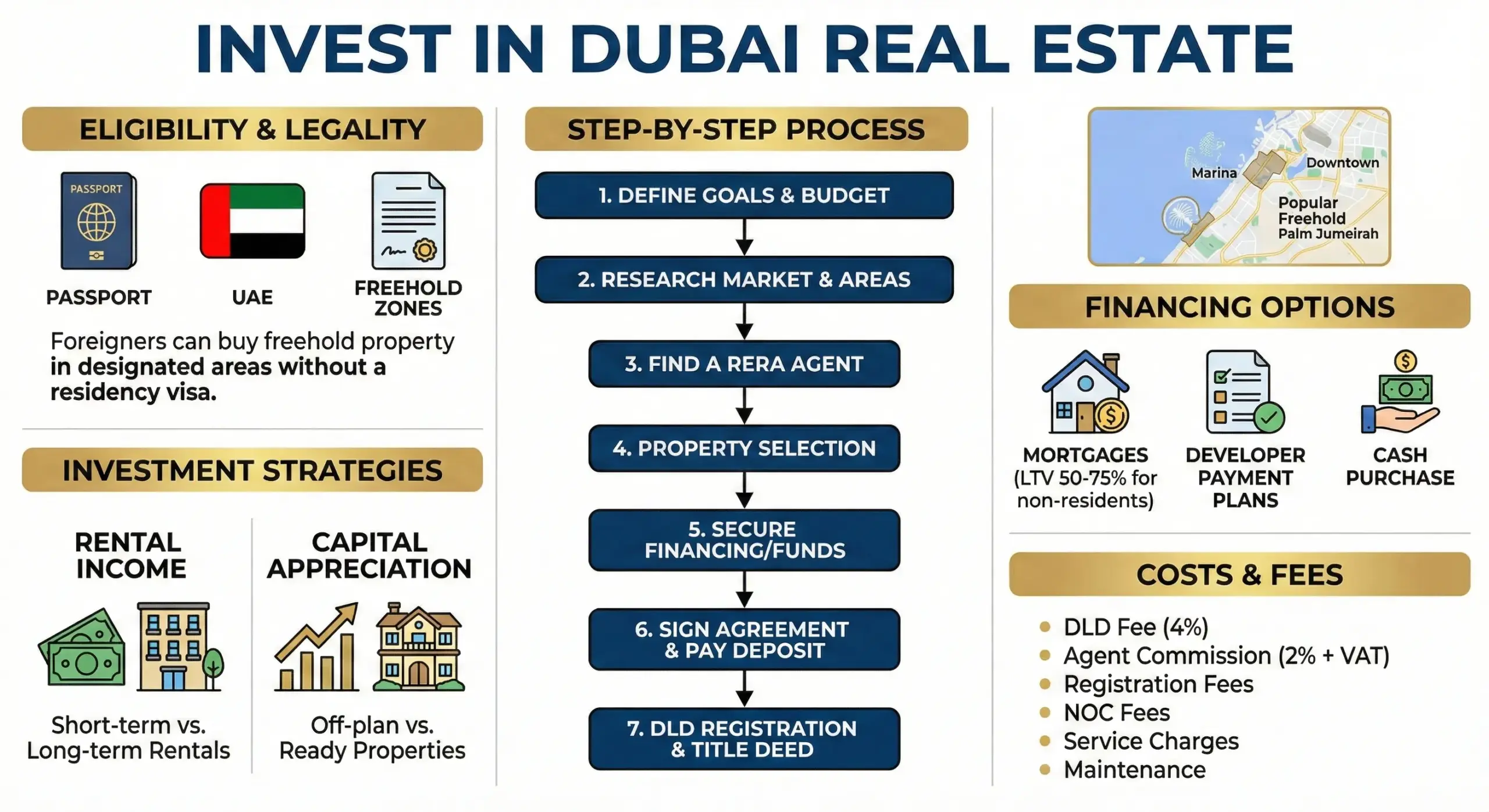
How to Buy Property in Dubai Step by Step: Practical Framework for 2026
Property Registration Dubai: Legal Process and Costs
Step 1: Pre-Purchase Due Diligence
Before identifying specific properties, establish your investment criteria:
- Budget range (inclusive of 7-10% additional costs for fees and registration)
- Geographic preferences (established vs. emerging communities)
- Property type (apartment, villa, townhouse, other)
- Investment horizon (owner-occupancy vs. pure investment)
- Financing strategy (cash vs. mortgaged)
The research team of Lykan’s Realty emphasizes that clarity on these parameters prevents costly errors and enables efficient property matching.
Step 2: Mortgage Pre-Approval (for Financed Purchases)
If pursuing mortgage financing, obtain pre-approval before house-hunting:
- Submit income proof, employment letter, and bank statements to chosen lender
- Lenders conduct credit assessment through Al Etihad Credit Bureau (AECB)
- Aim for credit score above 600 for favorable rates
- Pre-approval valid for 60-90 days; secures maximum borrowing capacity
Pre-approval provides budget certainty and strengthens negotiating position with sellers.
Step 3: Property Selection and Offer
Identify target properties through licensed brokers (preferably RERA-registered) or developers:
- Request comprehensive property details, including layout, floor level, utilities
- Review developer track record, completion history, and legal standing
- For off-plan: review payment schedule, handover terms, developer escrow protections
- Request comparable market data to establish fair value pricing
Step 4: Negotiation and Agreement
The property purchase process in Dubai typically follows:
- Submit written offer (Memorandum of Understanding) specifying price, payment terms, conditions precedent
- Negotiate terms including price reductions, furnishings, free maintenance periods, or developer incentives
- Payment terms commonly follow: 5-10% booking deposit, balance on contract signing, final payment at handover
- For ready properties: larger down payments (20-25%) with mortgage covering remainder typical
How to Choose Real Estate Agent Dubai: Selection Criteria
Professional real estate agent selection materially impacts transaction success and pricing outcomes. Lykan’s Realty team recommends:
Agent Credentials to Verify:
- RERA registration and valid license
- Minimum 3-5 years Dubai real estate experience
- Specific expertise in your target neighborhood and property type
- Professional association membership (RAEP, RECA, or equivalent)
- References from recent buyer/seller clients
Evaluation Process:
- Interview 2-3 agents; assess market knowledge depth and property-specific insights
- Request detailed comparative market analysis for your target property
- Confirm understanding of foreign buyer regulations and mortgage processes
- Ensure agent represents your interests (not developer’s) in transaction
Agent Compensation and Transparency:
- Broker commission is customarily 2 percent of purchase price, split between buyer’s and seller’s agents
- Confirm commission arrangement in writing before engagement
- Request written market analysis and property recommendations
- Ensure agent provides objective advice rather than pushing specific properties
Getting Mortgage Financing Approved in Dubai: Step-by-Step
1.For UAE residents (salary-earning professionals):
- Minimum monthly income: AED 5,000 (varies by lender)
- Maximum LTV: 80 percent for properties under AED 5 million; 70 percent for AED 5M+
- Down payment required: 20 percent for first property; 25 percent for additional properties
- For non-residents and expatriates:
- Minimum monthly income: AED 25,000+ (varies by lender)
- Maximum LTV: 65 percent for ready properties; 50 percent for off-plan
- Down payment required: 35-50 percent depending on loan category
- Mortgage Processing Timeline:
- Week 1-2: Property valuation (AED 2,500-3,500); lender confirms valuuation aligns with purchase price (lends on lower amount)
- Week 2-3: Final mortgage approval and Letter of Offer issuance
- Week 3-4: Sign mortgage agreement; pay arrangement fees (1% of loan, capped AED 25,000) and insurance
- Week 4-5: DLD registration with mortgage annotation; title deed issuance
- Mortgage Types and Rates (2026):
- Fixed-Rate: Interest rates from 3.75-4.5 percent; stable monthly payments; attractive for rate-sensitive buyers
- Variable-Rate: EIBOR + 0.75-1.5% spread; potential savings or increases depending on rate movements
- Islamic Mortgage: Sharia-compliant structures (Murabaha, Ijara); offered by Islamic and conventional banks
- Off-Plan Mortgage: Lower initial LTV (50%), increasing post-handover; extended terms to match construction phase
Dubai Property Ownership Laws for Foreigners: Legal Framework for 2026
Freehold Ownership Rights and Regulations
Dubai has the most welcoming property ownership rules for foreigners in the whole UAE. Foreigners (both residents and non-residents) can own completely freehold property, that is, they have permanent and inheritable rights like those of GCC citizens in almost all respects, in the designated areas.
Freehold Zones in Dubai:
- Dubai Marina and waterfront areas
- Palm Jumeirah and Palm Jebel Ali
- Downtown Dubai
- Dubai Hills Estate and Arabian Ranches
- Jumeirah Village Circle (JVC)
- Emirates Living
- Jumeirah Golf Estates
- Dubai South
- Expo City
- Plus 60+ additional designated communities
Total freehold zones represent approximately 50 percent of Dubai’s developable land, providing abundant choice for foreign buyers.
Leasehold and Alternative Ownership Structures
Beyond freehold, foreign buyers can access:
- 99-Year Usufruct: Long-term usage rights (not ownership) for designated properties, particularly in Abu Dhabi and some Dubai locations. Provides security comparable to freehold while maintaining land under government control.
- Musataha Rights: Building rights allowing foreign investors to construct on leased government land for extended periods (up to 99 years renewable). Primarily applicable to commercial and mixed-use development.
- Long-Term Lease (99 Years): Direct lease arrangements for extended periods, functioning similarly to ownership for investment purposes. Less common than freehold but available in specific communities.
Dubai Property Ownership Laws for Foreigners: Tax and Regulatory Advantages
Zero Taxation Benefits:
- Freehold properties are not subject to any property tax (major advantage compared to international markets).
- No income tax on rentals (all rents received go to the landlord).
- No capital gains tax on sales of properties (complete tax exemption on profits).
- No inheritance tax (properties inherit completely by heirs without taxation on estates).
In the long term, tax benefits lead to significant wealth accumulation. A property in Dubai with a 6 percent annual rental yield will give equivalent after-tax returns of 8-9 percent in tax-jurisdictions, thus making it a very attractive place for international capital.
Regulatory Protections for Foreign Buyers:
- Digital Title Deeds: Property ownership confirmed through electronic registry maintained by Dubai Land Department (DLD); immutable ownership record
- Escrow Protection: Off-plan purchases protected through RERA-mandated escrow accounts; developer funds held in trust until project completion
- RERA Dispute Resolution: Dubai Real Estate Regulatory Agency (RERA) provides investor dispute resolution through administrative processes faster and lower-cost than litigation
- Dubai Land Department Transparency: All transactions, valuations, and ownership transfers recorded in centralized database; full transparency and recourse
- Golden Visa Eligibility: Property purchases of AED 2 million+ entitle foreign investors to 3-10 year renewable residency visas, supporting family planning and business continuity
Inheritance and Succession Planning for Foreign Property Owners
Foreign property owners can establish inheritance through:
- Testamentary Will: Drafted through Dubai International Financial Centre (DIFC) or Dubai Courts; permits designated beneficiaries to inherit properties with legal certainty
- Sharia Succession: By default, UAE succession laws apply based on Islamic principles; alternately, foreign investors can elect DIFC law (common law) succession through specific documentation
Lykan’s Realty team emphasizes establishing written wills early to prevent succession complications and ensure family wealth transfers proceed smoothly. Professional legal guidance through DIFC counsel is recommended for high-value estates.
Common Mistakes Buying Property in Dubai: Lessons from Real Transaction Data
Top Seven Mistakes Investors Should Avoid in 2026
- Insufficient Market Research and Location Due Diligence
One of the costliest errors is purchasing in location without independent verification of future demand drivers. Early investors in speculative areas (e.g., certain JVC phases, Arjan projects) discovered that oversupply and weak tenant demand limited returns despite theoretically sound investment thesis.
Avoid this mistake by:
- Researching neighborhood growth catalysts (metro expansions, commercial development, school openings)
- Analyzing 3-5 year rental absorption rates through property portals
- Comparing per-square-foot pricing across comparable neighborhoods
- Preferring established communities with proven rental track records over emerging areas without validation
- Ignoring Total Acquisition Costs
Many buyers budget only the purchase price, overlooking critical expenses:
- Dubai Land Department registration fee: 4 percent of property value
- Broker commission: 2 percent (if using agent)
- Title deed issuance fee: AED 580 (apartments)
- Valuation fee: AED 2,500-3,500
- Mortgage processing fee: 1 percent (capped AED 25,000)
- Escrow fees (off-plan): 2-3 percent during construction phase
Total acquisition costs typically range 7-10 percent of property value. Budgeting only the headline price risks insufficient reserves and elevated leverage ratios.
Correction: Establish acquisition cost reserve equal to 10 percent of purchase price before committing capital.
- Over-Leveraging and Excessive Debt Service Ratios
Dubai banks enforce strict debt-to-income ratios: maximum 50 percent of monthly income allocated to all loan obligations (mortgages, car loans, credit cards). Buyers maximizing leverage often discover that subsequent income reductions or mortgage rate increases create cash flow stress.
Prudent approach: Maintain debt-to-income ratio below 40 percent, preserving flexibility for market downturns or personal circumstances changes.
- Purchasing Off-Plan Projects from Unproven Developers
Higher risk developers with limited track records face construction delays (60-80% probability), cost overruns, and quality issues. Investors in such projects often experience 3-5 year delays and forced refinancing when handover timelines slip.
Protection: Prioritize developers with minimum 15-20 year operational history, track record of on-time delivery (80%+ completion rates), and strong financial ratings. Emaar, Damac, Sobha, and Nakheel, despite occasional delays, maintain superior execution records versus emerging developers.
- Neglecting Legal Documentation and Escrow Protections
Off-plan buyers who fail to verify escrow protections expose capital to total loss if developers encounter financial distress. Legal loopholes limiting buyer recourse can eliminate investment value.
Protection: Before purchase, confirm:
- Escrow account status through RERA and chosen bank
- Developer RERA standing and historical dispute history
- Full details of payment schedule and conditions precedent
- Legal review of Sales and Purchase Agreement by qualified attorney
- Inadequate Inspection and Quality Verification (Ready Properties)
Completed properties may exhibit construction defects undetectable through virtual tours or agent descriptions. Issues such as structural cracks, plumbing failures, electrical problems, or noise complaints can emerge post-purchase, creating unexpected maintenance costs.
Protection: For ready properties, conduct comprehensive pre-purchase inspection including:
- Independent structural engineer assessment
- Plumbing, electrical, and HVAC system testing
- Sound level measurements during various times
- Building maintenance charge history and reserve fund status
- Common area condition and management responsiveness
- Failing to Negotiate and Accepting Initial Asking Prices
Market conditions in 2026 offer enhanced negotiation leverage compared to 2024-2026. Properties remain on market longer; builders offer incentives; sellers face increased competition from new inventory. Yet many buyers accept initial asking prices without counter-offers.
Opportunity: Present competitive counter-offer 5-10 percent below asking price. In stabilizing markets, 3-5 percent reductions are frequently achievable. For off-plan, request builder incentives (furniture packages, maintenance periods, or direct discounts) rather than accepting published pricing.
How to Negotiate Dubai Property Price: Strategic Framework for 2026
Pre-Negotiation Preparation and Market Intelligence
Successful negotiation begins with comprehensive market preparation:
- Gather Comparative Market Data
- Analyze 10-15 comparable properties in target neighborhood (similar size, floor level, age, amenities)
- Request price trends over 12-24 months from agents or online portals
- Calculate per-square-foot pricing variation across comparables
- Identify price outliers (overpriced or underpriced listings)
- Understand Seller Motivation
Properties remain on market longer for specific reasons:
- Overly aggressive pricing (owner reluctant to adjust)
- Lease completion approaching (financial pressure to sell)
- New project launch nearby (competition reducing buyer interest)
- Owner relocation or downsizing (flexibility on terms)
- Bank-mandated sale due to distressed circumstances
Understanding motivation provides leverage. Sellers facing time pressure accept lower offers; owner-builders prioritize speed over price.
- Establish Your Target Price and Walk-Away Point
Avoid emotional decision-making by establishing:
- Target purchase price (15-20% below initial asking price; refined based on comparables)
- Maximum acceptable price (ceiling representing fair market value per comparables)
- Non-price negotiation items (closing costs, included furnishings, maintenance period, rent guarantee)
Discipline on these parameters prevents bidding wars and overpayment decisions.
Negotiation Tactics and Counter-Offer Strategy
Initial Offer Strategy:
Present your first offer 15-20 percent below asking price, supported by comparable data and market analysis. This aggressive opening creates anchoring effect and provides room for incremental concessions. Many sellers adjust expectations when presented with data-driven offers.
Presentation Elements:
- Document: Prepare written letter outlining comparable properties, per-sq-ft pricing, recent market trends
- Credibility: Provide pre-approval documentation confirming financing capability (signals serious buyer)
- Justification: Explain offer rationale referencing comparable sales and market conditions
- Respect: Maintain professional tone; avoid accusatory language about property flaws
Counter-Offer Escalation:
When seller counters your opening offer:
- First Counter: Move 3-5 percent closer to seller’s position; request seller reduce their position equivalent amount; signal flexibility and good faith
- Second Counter: Shift focus from price to terms—request seller finance portion, extend closing timeline, include furnishings or rent guarantee
- Final Counter: Move to your maximum acceptable price; emphasize cash offer, quick closing, or other non-price benefits; signal final offer
Non-Price Negotiation Levers:
When sellers resist price reductions, negotiate:
- Included Furnishings & Appliances: Reducing net purchase cost without nominal price reduction
- Tenant Rent Guarantee: Developer/owner guarantees minimum rental income for 1-2 years
- Free Maintenance Period: Developer waives service charges for 1-2 years post-handover
- Payment Plan Flexibility: Extended timeline for final payment in exchange for accepting lower price
- Direct Discount vs. Broker Commission: Reducing agent commission redirects savings to buyer
Walking Away and Avoiding Emotional Decisions
Dubai’s abundant inventory in 2026 provides negotiating leverage. If seller refuses reasonable offers:
- Know When to Walk: Properties will remain available; additional inventory constantly entering market
- Avoid FOMO: Fear of missing out drives overpayment decisions; discipline prevents regret
- Set Deadlines: Establish offer validity expiration (48 hours typical); prevents drawn-out negotiations diluting focus
Successful negotiators recognize that the next property is always better than overpaying for the current option.
Understanding ROI Components and Yield Calculations
Real estate return-on-investment comprises two components: rental yield (annual income as percentage of property value) and capital appreciation (property value growth), creating total return.
1.Rental Yield Calculation:
Annual Rental Income / Property Purchase Price = Gross Rental Yield
Example: AED 70,000 annual rent / AED 1,000,000 property purchase = 7 percent gross yield
- Net Yield Calculation (more accurate):
(Annual Rental Income – Annual Expenses) / Property Purchase Price = Net Yield
Expenses include property management (5-8%), maintenance (2-3%), vacancy allowance (5%), and service charges (varies by community).
Example: AED 70,000 rent – AED 20,000 expenses = AED 50,000 net / AED 1,000,000 purchase = 5 percent net yield
- Capital Appreciation Calculation:
(Sale Price – Purchase Price) / Purchase Price / Holding Period = Annual Appreciation Rate
Example: Property purchased AED 1,000,000; sold AED 1,500,000 after 5 years = AED 500,000 gain / 5 years = AED 100,000 annual gain / AED 1,000,000 original = 10 percent annual appreciation
- Total Return Calculation:
Annual Net Rental Yield + Annual Capital Appreciation Rate = Total Return
Example: 5% rental yield + 8% appreciation = 13% total annual return
Target ROI by Community and Property Type (2026-2027 Expectations)
| Community | Property Type | Expected Rental Yield | Expected Annual Appreciation | Total Expected Return | Best Investor Profile |
| JVC | Apartments | 7.5-8.0% | 3-5% | 10.5-13% | Income-focused, first-time buyers |
| Dubai Silicon Oasis | Mixed | 8.0-8.5% | 4-6% | 12-14.5% | High-yield income investors |
| Dubai Sports City | Affordable Apt | 7.5-8.5% | 3-5% | 10.5-13.5% | Rental income emphasis |
| JLT | Premium Apt | 6.5-7.5% | 4-6% | 10.5-13.5% | Balanced income + growth |
| Downtown Dubai | Luxury Apt | 5.5-6.5% | 4-7% | 9.5-13.5% | Capital growth emphasis |
| Dubai Hills Estate | Villas | 4.5-6% | 6-10% | 10.5-16% | Long-term capital appreciation |
| Dubai Creek Harbour | Mixed | 6-6.5% | 6-8% | 12-14.5% | Growth + income balance |
| Palm Jumeirah | Ultra-Luxury | 4-5% | 5-10% | 9-15% | Wealth preservation, HNWI |
Optimizing ROI Through Purchase Timing and Property Selection
Timing Optimization (2026-2027):
Properties purchased in Q1-Q2 2026 benefit from:
- Peak market absorption period (heavy new supply increasing choice)
- Seller motivation elevated (inventory rising; time-on-market increasing)
- Negotiating leverage maximized (buyer’s market dynamics)
- Handover acceleration (completed inventory rising, reducing wait for income generation)
Properties purchased in Q3-Q4 2026 face:
- Reduced negotiating leverage (inventory saturation encouraging seller discounting)
- Potential price stabilization (supply abundance reducing appreciation prospects)
- Extended handover timelines (construction peaks in mid-year, extending completion)
Property Selection Optimization:
- Income Focus: Prioritize JVC, Dubai Silicon Oasis, Dubai Sports City communities (7-8.5% yields); accept 3-5% appreciation
- Growth Focus: Prioritize Dubai Creek Harbour, emerging Dubai South phases, new Sobha Hartland (6-8% appreciation); accept 5-6% yields
- Balanced Portfolio: 50% income properties (7%+ yields) + 50% growth properties (6-8% appreciation) = 6-7% blended yield + 4.5-5% blended appreciation = 10.5-12% total return
Expert Tips and Market Insights from Lykan’s Realty Team
1.Expert Tip #1: Focus on Emerging Catalysts and Infrastructure Plays
The research team of Lykan’s Realty identifies infrastructure completion as the most powerful appreciation driver through 2026-2027. Properties positioned near Metro expansions, new highway connections, or mixed-use district development generate outsized returns as connectivity completion increases rental demand and buyer appeal.
Example catalysts to monitor:
- Dubai Metro Blue Line: Planned completion 2029; nearby properties (Dubai Hills Estate, MBR City phases) appreciate ahead of opening
- Dubai South Airport Expansion: Al Maktoum Airport capacity increasing; nearby Expo City and Dubai South communities benefit disproportionately
- Creek Harbour Retail Activation: Waterfront dining, retail, and entertainment completion through 2026-2027 expands beyond-residential appeal
- JVC Metro Connections: Planned metro extension to JVC infrastructure completion drives rental demand expansion
Infrastructure investing requires patience (3-5 year investment horizons typical) but delivers 8-15 percent annualized returns for disciplined investors.
- Expert Tip 2: Diversify Across Multiple Communities Rather than Concentration
The Lykan’s Realty team emphasizes portfolio diversification reducing concentration risk. Investors placing 80-100 percent of capital into single communities face concentration risk if local oversupply emerges or infrastructure delays occur.
Optimal approach: Allocate capital across 3-5 communities, blending established neighborhoods (Downtown, Marina) with growth communities (Creek Harbour, Dubai South) and income communities (JVC, Silicon Oasis). This allocation smooths returns across market cycles and reduces single-property concentration risk.
- Expert Tip 3: Prioritize Developer Reputation and Track Record
Early investors in projects from unknown developers often experience 50-70 percent value loss when projects face delays, quality issues, or abandonment. Conversely, established developers (Emaar, Damac, Sobha, Nakheel) maintain 95%+ project completion rates.
Developer evaluation criteria:
- Minimum 15-Year Operating History: Guarantees organizational sophistication and financial stability
- 80%+ On-Time Delivery Rate: Historical track record of meeting handover commitments
- Financial Strength: Annual revenues exceeding AED 5 billion; strong balance sheets
- RERA Standing: Zero critical violations; proactive regulatory compliance
- Client Testimonials: Positive feedback regarding customer service and project quality
The AED 200,000-500,000 price reduction for purchasing from emerging developers is rarely worth the 3-5 year delay and 15-25 percent value risk exposure. Lykan’s Realty team strongly advocates for established developer preference.
Why This Blog Is Beneficial for Dubai Real Estate Investors and Buyers
1.Comprehensive Market Intelligence for Informed Decisions
The comprehensive guide provided by Lykan’s Realty team synthesizes 2025-2026 market data, expert forecasts, and transaction patterns into actionable insights. Rather than relying on promotional developer marketing or speculative agent claims, investors gain access to evidence-based analysis grounded in:
- Documented supply/demand data from RERA and Dubai Land Department
- Rental yield benchmarks across 15+ communities and 100+ property comparables
- Capital appreciation forecasts from Fitch, Moody’s, and Savills research divisions
- Developer completion statistics spanning 15-year historical periods
- Regulatory framework clarity regarding foreign ownership, mortgages, and legal protections
This intelligence foundation enables investors to align property selections with realistic return expectations, appropriate holding periods, and optimal financing structures.
- Risk Mitigation Through Due Diligence Framework
Lykan’s Realty team emphasizes that the “seven common mistakes” section of this blog prevents costly errors that collectively cost Dubai investors over AED 500 million annually. By understanding:
- How to avoid over-leverage and excessive debt-service ratios
- Why developer selection materially impacts outcomes
- How legal documentation and escrow protections work
- Which total acquisition costs are commonly overlooked
First-time buyers and experienced investors systematically reduce investment risk through a disciplined approach replacing emotion-driven decisions.
- Community-Specific Investment Strategies
Rather than generic real estate advice, this guide provides community-specific data enabling targeted investment strategies:
- JVC & Dubai Silicon Oasis: High-yield community strategies optimizing 7-8% rental income
- Dubai Creek Harbour & Dubai South: Growth-oriented strategies capturing 8-15% appreciation potential
- Dubai Hills Estate & Palm Jumeirah: Long-term capital appreciation and wealth preservation strategies
- Business Bay & Dubai Marina: Balanced income + growth strategies combining 6% yields with 4-6% appreciation
This segmentation enables investors to select strategies aligned with personal financial objectives: income maximization, capital growth, or wealth preservation.
2026-2027 Market Timing and Entry Point Optimization
For prospective buyers questioning “Is it a good time to buy in 2026?”, this guide provides evidence-based response: 2026 presents more favorable entry conditions than 2024-2025 for most investor profiles (except ultra-luxury), driven by:
- Increased inventory choice enabling selective purchasing
- Seller motivation elevated reducing negotiation friction
- More rational pricing after appreciation cycles
- Stabilizing rental markets supporting realistic yield forecasts
Lykan’s Realty team research indicates that disciplined buyers entering 2026 at fair-market pricing will generate superior risk-adjusted returns compared to 2024-2025 entrants overpaying during peak appreciation.
Conclusion: Market Positioning for Success in Dubai Real Estate 2026-2027
According to Lykan’s Realty research team, Dubai’s real estate market in 2026–2027 is shifting from rapid expansion to sustainable, fundamentals-driven growth. Rising supply is creating better pricing and selection opportunities for disciplined investors, while strong population growth, Golden Visa inflows, and economic diversification continue to support demand.
Rental growth is normalizing to healthier levels, improving affordability and long-term income stability. In this environment, location and developer quality are critical, and balanced portfolios combining income and growth assets across multiple communities offer the best risk-adjusted returns. While returns may be less aggressive than 2020–2026, the market now provides more stable, predictable opportunities, making proactive and well-researched investment strategies key to long-term success.
For official guidance on Dubai property regulations and ownership, visit the Dubai Land Department (DLD) and RERA for registration processes, fees, developer approvals, and investor protections. For residency and visa requirements related to property ownership, refer to the GDRFAD. For market insights and property data, the Property Finder UAE portal provides trends, transaction history, and community comparables.
FAQs
- Can foreigners buy property in Dubai easily?
Yes, foreigners can buy freehold property in designated areas without restrictions. - Is Dubai property tax-free?
Yes, Dubai imposes no annual property tax. - What documents are needed for property purchase?
Passport, visa, proof of funds, and mortgage documents (if applicable). - Can foreigners get a mortgage in Dubai?
Yes, banks provide mortgage options up to 75% LTV. - How long does property registration take?
Property registration in Dubai can take 30 minutes to 1 day using DLD Smart services. - Are off-plan properties safe in Dubai?
Yes, all payments go through RERA escrow accounts. - Does buying property in Dubai offer residency?
Properties worth AED 750,000+ qualify for UAE investor visas. - Is investing in Dubai better than India?
For ROI, transparency, ownership rights, and rental yields, Dubai leads India.
About The Author